
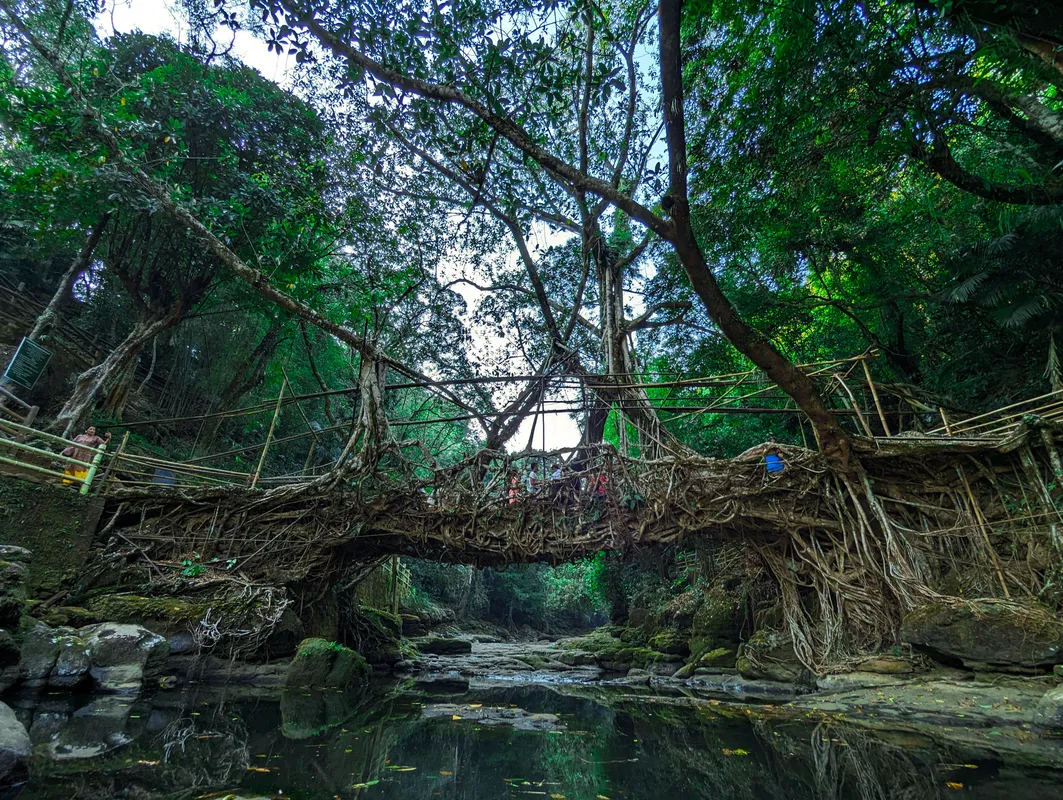
Cherrapunji · Khasi Hills
Cherrapunji Travel Guide — Root Bridges on a Budget
Best months
Per-day budget
₹680–1,550/day
Getting there
Cherrapunji, also known as Sohra, in the Khasi Hills of Meghalaya, was once the wettest place on Earth and still receives spectacular rainfall. The name draws visitors for the record books, but what keeps them are the living root bridges — the most famous being the Double Decker root bridge in the village of Nongriat. Cherrapunji sits on the edge of a plateau, and the landscape drops steeply into deep gorges where the waterfalls — Nohkalikai, the tallest plunge waterfall in India — fall hundreds of metres. The town itself is small and not particularly scenic, but the surrounding valleys, forests and bridges make it one of the most spectacular destinations in North East India. Everything here involves walking down into valleys and climbing back up, so bring good knees.
Plan your trip to Cherrapunji Travel Guide — Root Bridges on a Budget
Search and compare prices — we earn a small commission at no extra cost to you.
Flights
Hotels & Hostels
Trains
Search train routes, schedules and fares across India.
Buses
Compare bus operators, schedules and prices.
Why go
The Double Decker root bridge trek at Nongriat is the signature experience. It involves descending 3,500 stone steps into the valley, crossing several streams, and reaching a bridge made entirely of living fig tree roots that has been grown over generations to span a river gorge. A second root bridge sits a short walk downstream. The trek down takes about 2 hours and the climb back up about 3 hours. For those who want more, the trail continues to Rainbow Falls, a swimming spot another hour below Nongriat. Staying overnight in Nongriat village is highly recommended — it transforms the experience from a day trip into an immersive escape. The Mawsmai caves near the town are a lit, walkable limestone cave system.
Cherrapunji's viewpoint circuit can be done without trekking into the valleys. Nohkalikai Falls is visible from a viewpoint 10 minutes from the parking lot — the water drops 340 m into a green pool. The Seven Sisters Falls, Dainthlen Falls and Kynrem Falls are all visible from viewpoints along the main road. The Mawsmai caves are an easy, lit walk through limestone formations. The Echopark on the edge of the plateau offers views of the Bangladesh plains. The town has a handful of cafes serving Khasi food and the local 'tea at the clouds' experience.
How to reach
Cherrapunji is about 55 km from Shillong. Shared sumos from Shillong to Cherrapunji depart from the shared taxi stand near Police Bazar and take about 2 hours (₹200-300 per person). Confirm current fares and frequency locally before setting out. Private taxis from Shillong cost ₹1,500-2,500 one way. The nearest airport and railhead is Guwahati, about 170 km from Cherrapunji — a 4-5 hour drive via Shillong. Once in Cherrapunji, the main market area (Sohra) is walkable. The trek to Nongriat starts from a parking lot at Tyrna village, about 30 minutes by shared sumo from Cherrapunji market.
What a day costs
| Homestay / guesthouse | ₹400–800 |
| Food (dal-rice / noodles) | ₹150–350 |
| Local transport (shared sumo) | ₹100–300 |
| Cave entry fees | ₹30–100 |
When to go
October to April is the best period for trekking. The rain is minimal, the steps are dry, and the water at the root bridges is clear. November to February can be foggy in the mornings but clears by midday. May to September is the rainy season — the waterfalls are at full flow, the root bridges are surrounded by greenery, and the landscape is at its most dramatic. However, the 3,500 steps to Nongriat can be slippery and leeches are common in the wet months. If you come during the monsoon, carry a raincoat and leech socks. For the full waterfall experience, July-September is unmatched.
Suggested itinerary
Day 1: Arrive and Nongriat Overnight
Arrive in Cherrapunji from Shillong by midday. Take a shared sumo from Cherrapunji to Tyrna village (₹100-150, 30 minutes). Descend the 3,500 steps to Nongriat village — take 2 hours at a steady pace. Check into a homestay in Nongriat. Visit the Double Decker and single root bridges in the evening. Have dinner at the village homestay.
Day 2: Rainbow Falls and Return
After breakfast, trek from Nongriat to Rainbow Falls (1-1.5 hours below the village). Swim in the pool at the base of the falls. Return to Nongriat by midday. Climb the 3,500 steps back up to Tyrna village — takes about 3 hours. Take a shared sumo back to Cherrapunji. Visit Nohkalikai Falls viewpoint for sunset.
Day 3: Waterfalls Circuit and Depart
Visit the Mawsmai caves (₹30 entry) and the Seven Sisters Falls viewpoint in the morning. Walk the short Echopark trail on the edge of the plateau. Take a shared sumo back to Shillong in the afternoon.
Student hacks
- ▸Stay overnight in Nongriat village — it makes the root bridge experience far more worthwhile and the evening in the valley is unforgettable.
- ▸Carry leech socks or salt if visiting in the monsoon — the trail to Nongriat has leeches in the wet season.
- ▸The 3,500 steps to Nongriat are easier to descend than to climb — pace yourself on the way up and carry enough water.
- ▸Nohkalikai Falls viewpoint is ₹30 entry and a 5-minute walk from the parking lot — the best waterfall-to-effort ratio in Cherrapunji.
- ▸Shared sumos from Shillong to Cherrapunji leave when full — ask at the shared taxi stand near Police Bazar.
Safety & permits
Indian nationals do not need any permit for Cherrapunji or Nongriat. The main safety concern is the trek to Nongriat — the 3,500 steps are uneven and can be slippery when wet. Take your time on the descent and carry at least 1 litre of water. Leeches are present in the wet season — carry salt or a leech repellent. The root bridges and the surrounding forest are safe but remote — carry a power bank and a torch. There are small shops in Nongriat village selling water, snacks and basic meals. ATMs are available in Cherrapunji market. Mobile network is good on the plateau but patchy in the Nongriat valley.
FAQs
How do I reach Cherrapunji from Shillong?
Shared sumos from Shillong's Police Bazar stand to Cherrapunji take about 2 hours and cost ₹200-300 per person.
How difficult is the Nongriat root bridge trek?
The trek involves 3,500 stone steps down and back up. It is moderately difficult — doable for anyone with basic fitness. The descent takes 1.5-2 hours and the return takes 2.5-3 hours.
Can I do the root bridge in a day trip?
Yes, but you will be rushed. The descent, visit and climb back take about 5-6 hours. Staying overnight in Nongriat makes it a far better experience.
What is the best time to visit Cherrapunji?
October to April for dry trekking conditions. May to September for full-flowing waterfalls and the greenest landscape — but expect leeches and slippery steps.
Do I need a permit for Cherrapunji?
No. Indian nationals do not need any permit for Cherrapunji or anywhere in Meghalaya.
What should I pack for the root bridge trek?
Sturdy shoes with good grip, 1-2 litres of water, a torch, a power bank, snacks, and a change of clothes if staying overnight. Leech socks if visiting in the wet season.