
Spiti Valley Road Trip: Monasteries, High Passes & ₹1,500 Days
Youth Travel India ·
Spiti on student money: HRTC buses, Kaza homestays and high villages on roughly ₹1,500 a day.
→ Our Spiti Valley destination guide: costs, itinerary and hacks
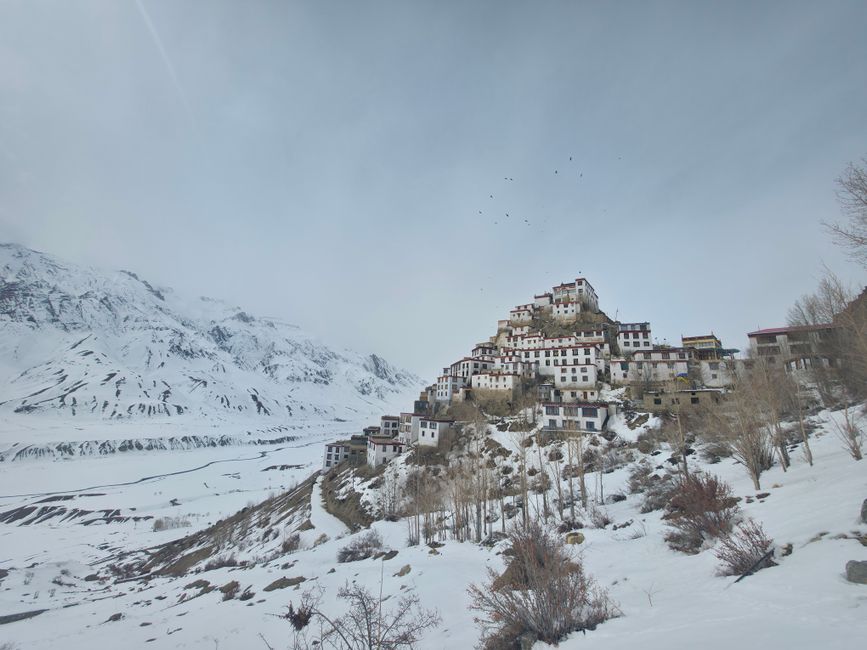
Spiti Valley is Himachal Pradesh turned inside out, a cold desert of brown lunar slopes with a silver river curling across the valley floor and monasteries like Key balanced on cliffs above it. The hub is Kaza at about three thousand six hundred metres, ringed by the high villages of Kibber, Langza and Komic. This guide shows how to do it on roughly ₹1,500 a day with public buses, family homestays and shared jeeps.
Getting there: most budget travellers enter through Shimla and Kinnaur because that road stays open the longest. Take an overnight bus from Delhi to Shimla for roughly ₹400 to ₹700, then an HRTC bus to Reckong Peo for roughly ₹300 to ₹500 in about eight hours, then another HRTC bus onward to Kaza for roughly ₹400 to ₹600. The full journey takes two to three days with halts.
The shorter Manali route crosses Kunzum Pass and reaches Kaza in ten to twelve hours for roughly ₹500 to ₹700 by HRTC bus, but it runs only while the pass is open. Shared jeeps fill gaps on both routes at roughly ₹500 to ₹1,000 per seat per leg, so team up at bus stands and homestays. The nearest airport is Bhuntar near Kullu, about two hundred sixty kilometres away. Recheck HRTC timings a day before leaving.
What it costs: a realistic Spiti day lands between ₹1,200 and ₹1,800, which makes fifteen hundred a fair planning figure. Homestays around Kaza charge roughly ₹500 to ₹1,000 a night, often with dinner included. Simple food like dal rice, thukpa and momos costs roughly ₹200 to ₹400 a day where locals eat. Shared jeeps between villages run roughly ₹300 to ₹1,000 per leg, while monastery entries stay between ₹20 and ₹100.
Carry all your cash from Shimla or Manali, because the ATM in Kaza works only off and on and there is no banking beyond it. Keep a cash buffer above plan for detours and weather delays. Homestays that bundle meals are the single best saver here. Split jeeps with four to six travellers and per person costs fall fast, so make friends on night one and plan the high villages loop as a group.
When to go: for most travellers the season runs June to September. Kunzum Pass typically opens in late May or early June after snow clearance by the Border Roads Organisation and closes around mid to late October. In twenty twenty five it opened near the end of May, right on pattern. July and August bring the biggest crowds plus a small risk of rain triggered landslides on the approaches, though the valley itself sits in the rain shadow and stays largely dry. September is the sweet spot.
October can work in the first half, but early snow may shut Kunzum with almost no warning, so keep your exit flexible. Winter from November to May is extreme, with deep cold and most roads and stays closed to ordinary travellers. Because the season squeezes into four months, book your first Kaza night ahead and arrange the rest on arrival. June and September give easier bus seats and quieter monasteries than the July rush.
Stay safe: altitude is the main risk here, not crime or traffic. Kaza sits at three thousand six hundred metres and day trips climb past four thousand five hundred metres, so rest through day one, drink water steadily and skip alcohol on arrival. Ask your doctor about medication for altitude sickness. Buy travel insurance that explicitly covers high-altitude road travel and emergency evacuation, since mountain evacuation is slow and costly. Indians need no Inner Line Permit for the core circuit but must carry photo ID for check posts at Jangi and Sumdo.
Foreign nationals need a Protected Area Permit arranged in advance through a registered tour operator, plus photocopies for every check post. Mobile signal is mostly BSNL around Kaza with patchy Jio elsewhere, and nothing at all across long stretches, so download offline maps and share your route with family. Headache, nausea and poor sleep on arrival usually mean you are adjusting, so rest and hydrate rather than rushing higher, and descend if symptoms clearly worsen.
A simple three-day sketch works well. Day one is arrival plus rest in Kaza, with a slow walk through the market, the monastery above town and the bridge over the river, then an early night. Day two is the high villages loop by shared jeep, starting at Kibber at about four thousand two hundred seventy metres, continuing to Langza with its giant Buddha statue and fossil slopes, and finishing at Komic, whose monastery at about four thousand five hundred eighty seven metres ranks among the highest in the world.
Day three belongs to Tabo Monastery about forty five kilometres away, whose thousand year old murals are called the Ajanta of the Himalayas. With an early start and an open track, strong groups continue from Batal toward Chandratal Lake at about four thousand three hundred metres, a turquoise crescent ringed by moraine. That leg adds rough hours, so confirm the road locally the previous evening and keep the next day loose for your exit.
Etiquette and the fragile desert deserve your care. Spiti is water scarce, so take quick bucket baths, refill your bottle at the homestay and carry every wrapper back to a town bin. In monasteries remove shoes where asked, walk clockwise, keep voices low and ask before photographing monks. Buy the small fossils Langza children sell for roughly ₹50 to ₹100 instead of digging hillsides. Foreign readers should secure an Indian electronic visa early and keep documents on them. For deeper background, read our full Spiti Valley destination guide.